Your Quest Bar orders help create more giveaways. Order today!

NEW! Working Search Button! USE IT!!!

Love BF as a blog? You'll love it even more as an e-mail newsletter. Get recipes, tips and more!

3 Things I Learned in Haiti That Changed Me

Untitled

I struggled with how to do this blog post. This trip was so educational for me. I learned a lot about Haiti, about the world, but especially about myself. It would be impossible to summarize in one blog post. So I thought I’d concentrate it to the thee big things I learned that truly did change me.

But first…

Why exactly were you in Haiti, Nik?

Quiet as it’s kept, Bariatric Foodie is not my only “job.” My “day job” is as the staff writer for an organization that helps people around the world fight poverty and build strong livelihoods (and proud as I am of that work I will decline to name said organization because I like to keep my BF life and my day job life somewhat separate – thank you for understanding!). I traveled to Haiti to see our work there with coffee farmers and to document that work in video. I traveled to the city of Cap Haitien, which is about 6 hours north of Port-au-Prince, not that far from the border to the Dominican Republic. We also visited coffee farmers at two cooperatives, both high up in the mountains about 3 hours further north.

Without further adieu, here are my three things.

With a little support, you can overcome even the most difficult obstacles.
Untitled

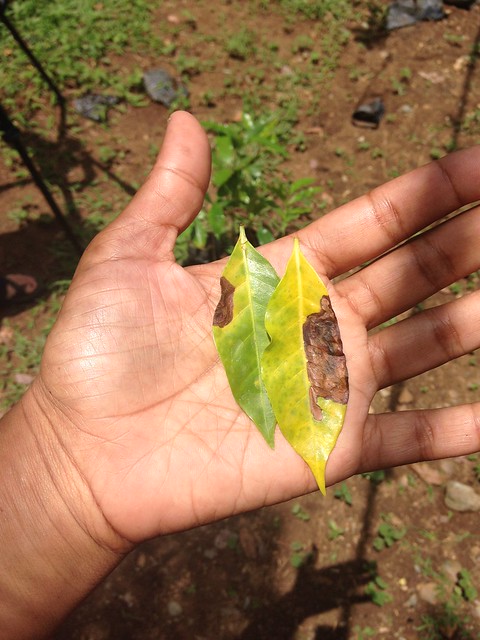
This is a photo of two leaves from a coffee tree that was struck by leaf rust, a disease that can kill coffee trees. Coffee farms all over the Caribbean and Central America have been affected by it. While I was in Haiti I got to see and hear a lot about leaf rust. It’s a truly devastating disease. It kills the branches of a coffee tree so it can’t produce “cherries” (little berry-like fruits that contain coffee beans).

To understand the full impact of that you have to know how coffee farmers use coffee to support themselves. Think of it almost like the reliability of your direct deposit in your bank account. Most farmers grow food they can eat. Coffee provides cash for all those other little things you must pay for like school fees for children, medical care and food to supplement what you grow. Many coffee farmers lost 60% or more of their coffee crop to leaf rust. That meant they saw a dramatic reduction in their income. Some dealt with it by switching their kids to less expensive schools. They knocked back on their amount of meals per day. It’s hard but folks are surviving.

They are coping by putting more effort into growing food for their families to eat but also testing out coffee plants that seem to resist leaf rust. They aren’t panicking. They are being organized, addressing their immediate needs and trying to recover for the future. 

My Big Lesson: We face those situations sometimes too. Things that want to derail us. Knock us off of our big plan. I know in the past I’ve freaked about it. These farmers taught me that the most effective way to deal with those situations is to determine what you need most right now and work on that then, little by little, work on getting back to where you used to be.

Accept your shortcomings, get out of your own way, and great things can happen!

Little Mama

I wish I could tell you the names of these little girls. They are absolutely adorable (although this photo makes them look sort of serious). On our second day of shooting, high in the mountains, I was taking a quick break while our videographer got some footage of a coffee farmer’s house. The village we were in had quite a few houses relatively near one another and all had little kids laughing, playing, eating mangoes (from the trees in their yards!).

This little girl is six. Her sister is about two. And that was about the only thing I understood that she said. In this region, Haitian Creole is the first language. Kids learn French in school but she was a bit young to know much French.

When she approached me she started asking questions (universally I think our intonation is about the same when asking a question). I think she was asking me what we were doing and about the cameras. I had our local staff close by BUT they speak Creole and French but no English. I speak English but no Creole and French. And I was stressed out about that for a minute.

But then that sweet little girl smiled and started chatting on, not really caring that our words didn’t match up. It was a magical moment for me.

My Big Lesson: Accepting your shortcomings is not the end of the world. I didn’t speak Creole and I wasn’t going to try to butcher the language at that point. I also decided I wasn’t going to feel bad about not speaking Creole. The little girl certainly didn’t feel bad about not speaking English. And she also didn’t see it as a barrier to making a new friend. I think I need to be like that more in life. Shortcomings are a challenge, yes, but they don’t make or break my ability to survive a situation.

You only get one life and if it’s a damn shame if you waste it feeling bad about yourself.

Untitled

I got this picture going up the mountain. Oh my goodness there was so much to see! There were people working in the fields. There were cows. There were pigs and chickens and baby goats that seemed to be playing tag with one another. There were streams and flowers. And bugs, yes, bugs!

But then there were also the mountains. I was awe-struck by them. My photos don’t accurately capture the scale of these mountains. They were majestic and beautiful. I have always loved mountains because they make you realize how small you are relative to the universe. Our individual worlds are so small that our problems sometimes seem to fill them up. The mountains expand that world (at least for me) and put things into perspective.

I could have focused on the bumpy ride it took to get up that mountain (I banged my head on the top of our truck about 57 times and I’m lucky I didn’t get a concussion!) but I was too busy being in awe of what was going on around me. There were many moments like that on this trip, where folks were having serious discussions and I just wanted to look out the window, drink it all in.

My Big Lesson: Life really is amazing, Foodies. And if you’re not careful, in the immortal words of Ferris Bueller, “if you don’t stop and look around every once in a while, you might miss it.”

So there you have it. Three big things I learned while in Haiti. I didn’t take a whole, whole bunch of pictures but I did get a few shots. Here are my best ones. If you’d like to know anything more about the trip, drop a comment. I’m happy to answer!

Untitled
These are bananas on a tree. I had never seen a real banana tree before so I didnt' know what to make of that large...vine? With the flower on the end. I won't lie, my inner 12 year-old had a field day.

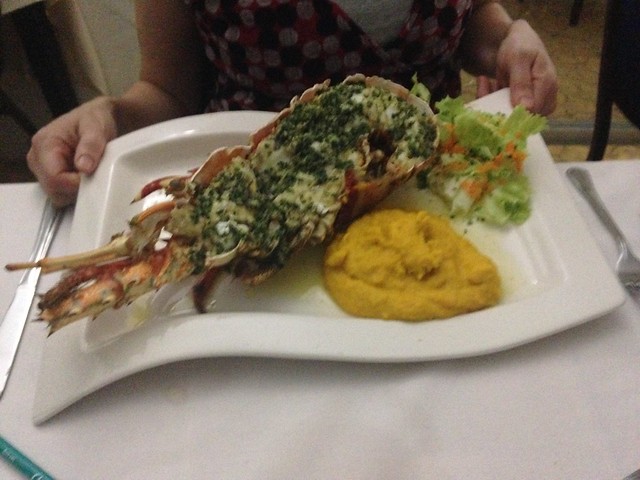
The massive lobster tail
It's a bit fuzzy, but this is one thing Cap Haitien is known for. Lobster! My co-worker ordered this dinner (which, by the way, was a paltry $18!) and we were all really surprised byt he size of it (it's wider than she is). That's all lobster meat by the way, with seasonings on top.

Untitled
This painting hung outside my hotel room door and I think it captures the spirit of Haiti very well. There's always stuff going on! Life doesn't stop. People are moving about, to and fro. It's a very industrious place but you can tell the people take care of one another and themselves!

Cap Haitien is a jogging city
Speaking of taking care of yourself...this is one lone jogger early in the morning. But by about 7 a.m. there are THRONGS of people - locals - jogging. Old people, young people, plump people, skinny people. Literally...there were dozens. It was inspiring!

There are even more pictures on my Flickr account. Feel free to check them out if you like! 

7 Things in 7 Years: What I’ve Learned Since Having Weight Loss Surgery

Me pre-op versus a few months ago. I'm using this "after" pic because it's cold today and I look a hot mess so I don't want to take a picture, k? I'm the exact same weight today as in the picture (and yes, that weight IS over 200 lbs.)

Sad, but true fact: I didn’t realize today was my surgery anniversary until my friend Pam congratulated me. Wow. (I call that a “Nik Moment”)

In honor of this momentous occasion, I’d like to share seven insights I’ve learned in as many years since my surgery. In no particular order.

Balance is way more important than perfection

As a newer post-op I was something of a health zealot. Some of you know me from back then. If you do, you know I’m the girl who once reamed a fellow post-op out for eating strawberries because strawberries are (gasp!) CARBS!

The truth of the matter is that it’s not so important to do everything perfectly, but to find things you can stick with. That’s why when folks ask me what’s the best protein powder, I answer, “The one you can stick with using.” What’s the best form of exercise? “The one you’ll keep doing.” This is a marathon, not a sprint. Which brings me to my next point.

This fight never ends.

You don’t graduate. There is no finish line. That may depress some of you but it is reality. Science is beginning to give us some insight about obesity. One thing I learned at Obesity Action Coalition Convention one year was that the metabolic systems of obese people are different from those of people who never had a weight problem. That means that we always have to be mindful of what and how much we eat, we always have to be living a healthy lifestyle, if we expect to keep the weight off and remain healthy. However…

I refuse to be on a diet for the rest of my life

One thing you’ll notice about Bariatric Foodie in general is that I am not afraid of food. I like cookies. (Note: I can’t eat too many of them because my body reacts to the sugar!) I sometimes eat McDonald’s. I have an abiding peanut butter addiction. I did not go through this process to be on a strict diet for the rest of my life. My goal, instead, is to live healthfully and mindfully. When I’m honest with myself, most of the time the healthier stuff is what I want (I mean, have you seen some of my recipes? Holy healthy NOM!). So I try to focus on living life, rather than restricting it.

The person I thought I’d be once I lost the weight does not exist

But in my head she was something. She was powerful and successful and happy and everybody LOVED her! She traveled, she bought fabulous clothes, had a wonderful boyfriend and, frankly, they both loved seeing her naked (hey, you guys always say I keep it real here!).

But here was the tricky part. In my head I wasn't allowed to be that person until I reached a certain number. And so YEARS went by and I was still waiting to start my life. Each day that didn't happen I felt more and more like a failure. The crazy thing was I was succeeding in so many other ways but I wasn't giving myself credit for it.

So the bottom line is this: at my lowest weight I was stressed out, insecure and lonely. It should have been the greatest time of my life. For goodness sakes, I hit a size 6 at one point! But things only began to change when I allowed myself to be the person I want to be now instead of waiting for some milestone. 

Hard stuff is still hard

Long-time readers know I went through the worst year of my life in 2012. My mother died, I lost our family home to the housing bubble. It was a dark, dark year and I was happy to see it end!

As hard as it was, I’m proud I was able to get through it without going bonkers with my eating. I think it’s because the stuff I dealt with was so painful, that I actually did reach out for help. I couldn’t withstand those sorts of shocks on my own and I didn’t even try to. I asked for hugs when I needed them. I cried. I stopped blogging for a while. I took long walks and argued with my mother, God and any other entity I was angry with.

Hard stuff will still happen to you as you are losing the weight. But it’s ok, you can get through it.

There are a million interesting things about me…weight loss surgery is only one of them

There was a time when my entire life revolved around weight loss surgery! But that’s only one part of who I am. Around year three, I began to nourish the other parts of who I am. I’ve shared that I’m a professional writer. I am almost finished earning a master’s degree in communications. I’ve written a few manuscripts (one day I may seek publication, until then…). I have two wonderfully insightful teenaged daughters, a batsh*t crazy Basset Hound and a Samurai black cat. I volunteer a lot. I enjoy singing and dancing and weight lifting and…

Get the point? It sounds weird to say but I didn’t know myself that well before surgery. I didn’t know what fed my soul or what made me excited to get up in the morning. Now I do and I am so grateful for that knowledge – and it keeps on building!

Everyone’s picture of success looks different

I started at 330 lbs. My lowest weight after surgery was 172 lbs. My highest weight after hitting my low point was 215. I haven’t checked my weight in a while, although I’m thinking I’m somewhere around 210. Yes, this scares the crap out of most of you. To answer your question, no I’m not afraid of gaining it all back. I don’t think I will, although it’s certainly possible. But given the fact that I love to exercise, I move a lot and I generally eat a pretty balanced diet, no matter what size I am, I’ll be healthy.

And that’s my picture of success. Yours may be to get to a certain weight. Or a certain size. And that’s fine! Within this community I simply ask that if you don’t knock my picture, I won’t knock yours.

So there you have it…seven of the many things I’ve learned since my weight loss surgery. Thanks for being a part of this crazy ride with me!

Check out my journey! Here are past year's surgery anniversary reflections:
(As you can see I've been inconsistent in documenting this!)

Four Things You Should Never Say to a Person Who Had Weight Loss Surgery


This is inspired by a piece done recently on The Today Show: 6 Things You Never Say to Someone Who Has Lost Weight. Those things apply but I feel like there's things people say to us after our surgeries that are just wrong (and some are potentially harmful) so here goes.

"Yeah, I'm losing weight the hard way."

Ok so I should start off telling you that here at Bariatric Foodie we call folks who haven't had weight loss surgery "non-ops." And I got some push-back on that. Listen. It's not a derogatory term. It's simply a term to distinguish someone who has had WLS from someone who has not. Having said that...

You. Non-op. Come closer so we can speak.

Imagine waking up tomorrow and your stomach was a fraction of the size it was before. Imagine taking your first bite of food in the morning and that bite of food makes you violently ill - and you don't quite know why. Imagine everything you eat makes you violently ill. Imagine going out to eat with friends and being done your whole meal before your friends have taken three bites of an appetizer. Imagine having the whole world see you shrink into a person you don't know and have never been before, all while you are supposed to be joyful (instead of freaking out, which is what you really are). Imagine having to remember to take vitamins every day. Imagine having doing the same workout you are doing "the hard way" except your body has only a fraction of the calories to sustain it. Imaging going through all that and having someone imply that you are doing things the "easy" way.

No matter what way you do it, losing weight is hard. So don't say that anymore.

"My sister's cousin's boyfriend's ex-girlfriend's sister had weight loss surgery and they gained all their weight back."

Firstly, no they didn't. That person is an urban legend. While folks who have weight loss surgery can regain, you probably don't know that person.

Beyond that, if you believe in the power of positive thinking, this statement can be really destructive. It spawns fear, self-doubt, self-consciousness. Weight loss surgery patients live in a constant tension between adhering to many guidelines and trying to live a normal life. Many of us are already so petrified of regain that, for all intents and purposes, we've actually worked in earnest to develop eating disorders.

A better thing to say is "I wish you all the best" and leave it at that.

"You've lost too much! You need to stop."

On this one, I have a bit of sympathy. Chances are your friend or family member was overweight or obese for a while before having surgery. And there's a good chance you only ever knew them that way. They are going through big changes. They are shrinking fast.

Rest assured your loved one is being monitored by an expert medical team. They have a bariatric surgeon, a registered dietician and other staff who monitor their weight very closely for the first two years after surgery. Very often their weight and health is monitored pretty closely even after that.

Each person has a different way to determine their goal weight. Unfortunately, it's not up to you to decide what that weight is. Telling someone they've lost too much is just as bad as telling them they have gained too much weight. It promotes low self-esteem and self-consciousness.

A simple "Wow, you've lost a lot of weight!" is both honest and much more respectful.

And lastly my personal favorite...

"You've changed since you had surgery."

My initial response the first time someone said this to me was "Well...yeah. Isn't that the point?"

My grandmother had a wonderful saying. "If nothing changes, nothing changes." Obesity is not just a disease of eating. Our environments, emotions and stressors can all contribute to our obesity. The only way to sustainably address obesity is to work at all of its causes in our lives.

That said, if your loved one suddenly is less tolerant of demands on their time, or they take longer to get ready to go out the door because they want to look nice, or they like to go clothes shopping, YES they have changed. No, that's not necessarily a bad thing.

On the same token some of us go through a serious "butthole phase" where we are a bit self-centered and hard to deal with (present company included). In those cases, address the behavior in particular. For example, if you find your loved one talks nonstop about their post-op life, you might say: "Hey, I know you've got lots going on, what else is happening in your life?" We go through stages after surgery and we are human. If we are being inconsiderate it may be a stage and we may not be aware we are doing it. But implying that it's bad we are changing isn't helpful or constructive.

If we're doing something that bugs you, talk to us respectfully about the thing we are doing instead of generalizing. Bonus: you actually have a chance of working it out when you do it this way!

What I've Learned About Eating From Different Food Cultures

I’ll start this off by saying I apologize in advance for any inaccuracies about cultures. I’m speaking based on my own understanding.

But still. I’ve eaten a lot of different kinds of foods with a lot of different kinds of people. As a lover of international cuisine, I am quite passionate about authenticity so I work hard to seek out the spots that aren’t touristy, but the places where folks of that same culture go to get food (When eating Greek, go where the Greeks go!).

And I notice different cultures have different ways of eating that I find inspiring. I think I’ve learned something about eating in general from every culture whose food I’ve tasted but here are a few highlights.

Judaism


While I’ve not experienced eating at a real Seder, my church once re-enacted a Seder (I told a Jewish friend what we ate and she tried very hard not to laugh). What strikes me about this ritual meal is that each food represents something. It tells a story, conveys an experience. There is a ceremony to eating at a Seder and that’s for a purpose as well (I won’t even go into trying to explain the purpose. I know I have Jewish Foodies who can spare me the taste of my foot in my mouth!)

The Big Lesson: It’s ok for food to have meaning beyond fuel for your body. Your family’s dishes are steeped in history and experience. I think in this modern age we sometimes get away from that. That’s why, for me, cooking with others (especially others that I love) is so meaningful. We actually talk about how we came upon the dishes we are making, how others made them before us, what sensory memories we have as a result.

Ethiopian


I think Ethiopian should be the official food culture of Bariatric Foodie. What says playing with your food better than eating with your hands? Many African cultures eat with their hands, using a piece of food as their utensil. In Ethiopia the most common food-utensil is Injera Bread. I admit I wasn’t always a fan. It’s a flat bread that has a soft, almost sponge-like texture and is slightly sour. When you go to an Ethiopian restaurant you can get foods served on a gigantic piece of Injera bread and to eat the foods on top of it you tear bits of the bread and scoop the food up.

The Big Lesson: It’s ok for eating to be fun. Also eating is function of more than just filling our bellies. Yes, we already know it involves the tongue and the different parts of the digestive tract but there is also a certain satisfaction derived from having your hands in food. I find when I cook and I have my hands in food, I eat a lot less. My theory? Part of my need to be in communion with food is satisfied by touching it. I don’t always need to taste it!

Chinese


Dim Sum, anyone? That’s a term that references a style of eating Chinese food where instead of one big plate of food you are served very small portions of many different things.

I would call Dim Sum the official food culture of Bariatric Foodie BUT there is the possibility of going completely overboard (and I have even as a post-op).

What strikes me as so special about Dim Sum, though, is the care that goes into creating such a tiny amount of food. When I’ve been presented my little plate it’s been beautifully arranged and even though it’s only one or two bites they are deeply satisfying.

The Big Lesson: It’s not the quantity of food on your plate that makes for a great eating experience, but the quality. Good food tastes better! I used to think since I couldn’t eat much there was no point in putting any effort into my food. I soon found I was wrong! Mindfully and carefully preparing well flavored dishes is a source of joy in my life.

Japanese 


Now I’m not sure if Hibachi is straight-up Japanese or Japanese-American (I’m sure someone will chime in with the answer) but I absolutely LOVE going to hibachi restaurants. If you’ve never been, it’s essentially a table where you sit with others (who you may or may not know) and in the center is a grill where the chef cooks your food for you. In the process he does some neat tricks on the grill (food tosses, creating big fires, etc. etc.). Then he skillfully prepares each person’s dish to their specifications.

The Big Lesson: Like it or not, food is social. That’s the one thing I think hits us the hardest after WLS. We think we can’t be social about food anymore. Our tiny portions, our “special food” make us seem like outsiders and sometimes we’d just rather not bother. But don’t shut yourself away! Eating is a good time to sit down and talk to people. And that can have a stress relieving effect that can actually cause you to eat less.

What’s your Favorite?

What’s your favorite eating culture? And what has it taught you about making eating more enjoyable (because...um...we're still allowed to enjoy eating!)

Nik Manifesto: Three Ways of Thinking that Can Hurt Your Weight Loss

Every once in a while, when the stars align correctly, I get in the mood to write a manifesto. The disclaimer here is that these are my thoughts. I’m not a doctor. I’m not a registered dietician. I’m not a psychologist. But I am a post-op who comes into contact with a LOT of other post-ops on a day-to-day basis and so when I see trends, I speak on them. I always expect that my manifestos will get me cursed out but somehow it usually turns out ok.

Today I’d like to talk about our expectations out of this process. Because from where I sit some of our expectations can be a little…interesting.

In jest, I call some of these expectations “fallacies,” mostly because the thinking behind them can be potentially harmful (and when I say harmful I mean both emotionally and, in some cases, physically). So I’ll dive right into the three most common ones I see.

The Fallacy of Equity

This is a fancy way of saying that I see many post-ops who believe that if everyone follows the same rules after surgery, everyone should get the same results. Some folks even believe that because they feel they work harder than other post-ops they should see better results.

These are FALSE. I’m living proof of that! I followed the rules of my surgery to a “t” for the first two years post-op. I exercised like a demon (there is documentation of this), I ate the proper number of calories, I was a protein champ. I never, ever saw this so-called “normal” rating according to the BMI. In fact, most of you will get an average of 20-40 lbs. smaller than I was at my smallest!

That’s not a rant on my part but I am saying this. Like most other statistical measures, WLS results are measured in broad trends, not individual numbers. Surgeons expect a certain percentage of your body fat loss based on the general trends they see, along with any influencing factors that apply to your body. But, again, that is relating you to you. Not to anybody else. So just because so-and-so lost a hundred pounds in four months does not mean you will NOR does it mean that you are a failure if you don't. Your body is your body. Don’t compare to anyone else!

 Bottom line: We are not all the same. And we, as post-ops, aren’t always the best equipped to make apples-to-apples comparisons. So instead of worrying about so-and-so, stay on your plan.

The Fallacy of Graduation

I see this one a lot. I practiced this one from years 2 – 4! This is the fallacy that allows mid- to longer-term post-ops (and sometimes even very ambitious newbies) to believe that they have “graduated” from obesity. Perhaps they’ve reached a certain weight, their labs look fine, they feel great and they think, “Ok, I’m not obese anymore! I don’t have to live by any rules anymore. Yippee!”

That is FALSE. I hate to be the bearer or discouraging news but once a post-op, always a post-op. And to go even deeper, science is starting to tell us that even when our bodies get to be a normal size, our metabolism will probably always be that of an obese person.

Now you can choose to interpret this information as discouraging. You may feel hopeless. I personally don’t see that as the point. To me, the point is that, on some level, we have to continue to work at our health for our entire lives. This should not be discouraging to any of you because even healthy non-ops have to work at their health for their entire lives. It’s a fact of life. The body takes maintenance. For us, that maintenance includes being aware of what we eat, how much we move, taking vitamins, drinking water.

Bottom line: While your life won’t always be centered on the WLS process, the WLS process will always be at least a small part of your life. You don’t graduate, pass go or collect $200.

The Fallacy of Similar Consequences

This one is similar to the Fallacy of Equity but slightly different. Again, this is one I have been especially guilty of throughout my process. The thinking goes a little something like this.

“I exercise and do everything I am supposed to. Jane does not. In fact, I see she eats cookies and still maintains a great weight loss. So I should be able to eat cookies.”

Now…first, divorce yourself from the specific example because cookies could be anything, even stuff that isn’t food. Cookies could be exercising enough, taking your vitamins or myriad other things. The point here is that we sometimes see others doing things we want to do (and believe me, I get the desire to just let loose, I really do!) and think that because that person didn’t have any visible negative consequences, you won’t either.

That is FALSE. The thinking is at least. You could very well not have many adverse consequences to relaxing your personal rules (although I can say with confidence that eventually not taking your vitamins usually catches up with you!). BUT you should always make those decisions based on factors related to you, not anybody else. Jane is Jane and you are you. Just because Jane can eat cookies every day and maintain her weight does not mean that’s what you should (or even want) to do. Am I making sense here?

I’ll give you another personal example. Not only have I always trended higher on the scale than most other post-ops but I’ve almost always been able to eat more. And there was a time when I followed the Jane’s of the world into some new habits. In and of themselves said habits weren’t so bad, but they weren’t the right decisions for me or my body. So they did not have favorable results. I had to learn that even though Jane was doing things I wished I could do, I could not do them. I don’t get the same result as Jane. Why? Because my body is different from hers!

There are many, many more of these so-called lines of thinking that I see, but these are the ones I see most commonly. I think in general this is a learning process. And far too many of us (present company included) have to learn this stuff from the School of Hard Knocks. Insofar as I can give a little insight that may help you recognize these patterns and act on them (if need be), I feel my mission is accomplished!

Keep playing with your food, Foodies. :)


BF Top 5: Mistakes You're Making on the Scale (that are driving you crazy!)

I won’t go into my personal history with the scale. Mostly because it’d be a whole blog post (or series of) by itself. What I will say is that this one inanimate object (it really is inanimate people!) seems to wield a lot of power over us – how we think, how we feel about ourselves and, sometimes, what we do or do not eat.

So I thought I’d go over a few “scale mistakes” if you will. Things people do that actually help the scale to drive them crazy. I purposely refrained from putting “weighing every day” on the list. I’ve heard from many of you that you feel you need to weigh every day for accountability and if you are using it to do that, I can’t really argue with that (although I personally don’t do it). But here are a few other scale mistakes I see people make all the time!

You weigh at different times of the day.

In a life existence where two pounds lost or gained can be the difference between elation and utter discontent, it confounds me that people weigh at various points of different days.

There are several reasons why our weight fluctuates throughout the day and they can basically be boiled down to this: you “take in” matter during the day. Matter has weight. That weight will show up on the scale.

If you drink 16 oz. of water right before stepping on the scale, you’re adding a full pound onto your body weight (provided you didn’t use the bathroom before weighing). Each meal you eat adds weight, not necessarily as weight gained but matter that is sitting in your digestive system. And, of course, poop has weight too.

Bottom line: Try to weigh around the same time every day if you MUST weigh every day. That will give you a more accurate idea of how you are progressing.

You weigh several times a day.

Yes, you may see incremental changes but there is no good reason you need to weigh yourself multiple times a day. As I said in the above point, you are more likely to weigh more as the day progresses than less (there are, of course, exceptions to that rule), so unless you like feeling bad about yourself, pick a time, adhere to it and do it once!

Bottom line: Weighing several times a day can be symptomatic of a thinking process that isn’t entirely balanced and healthy. Only you know whether that’s the case for you. If it is, know this: unhealthy thinking (most times) breeds unhealthy behavior. When we work toward a healthy mindset, healthy habits and healthy results are more likely to follow.

You weigh after exercising.

My trainer was the first person to let me know what a bad idea that is (unless, in my opinion, you consistently do it at that time so you can see the overall change and not just the change from before you work out). Especially when strength training, you are tearing muscle and exerting yourself. The body uses many things, including water, to recover from those activities. I’ve had more people than I can count email me distraught because they “gained weight” from exercise.

A small uptick in weight after starting or bumping up an exercise regimen can be normal. NOTE: Excessive gain is NOT. Yes muscle is more dense than fat (it does not weigh more than fat but it is denser) but even that isn’t going to cause a significant weight gain. More than a few pounds that stick around more than a few days and I’d say you may need to look at what you’re doing and adjust (I am, of course, not a nutritionist or a fitness professional, however, so your first step might be to seek out one of the two.)

Bottom line: Exercise can cause weight fluctuations and we should not expect to see instantaneous results on the scale from exercising. So afterward is probably not the best time to weigh, especially if you are weighing several times a day!

You allow the scale to dictate your actions.

Sigh. I used to be guilty of this one myself. If my weight didn’t come in where I wanted it to be, I skipped a meal. Or I exercised long and hard without properly fueling my body (and more than once hurt myself!). I’ve heard of people doing the opposite: being distressed by what the scale says and going on to make unhealthy eating choices or throwing their hands up and saying, “why bother!” with regards to exercise.

Bottom line: Weight loss is a tricky process. It’s not ever something the human body wants to do nor is it what the human body is built to do. Thus, you are going to face challenges. There will be stalls. Long ones. There will be points where you have to push harder, longer and almost reach your breaking point before you see a downward trend on the scale. But take heart. Your body is changing. It’s even possible for your body to be shrinking even if the number on the scale isn’t! But being reactive isn’t going to help. In my nearly 6 years as a post-op I can say I have never, EVER seen that mentality end well.

You avoid the scale altogether.

Yep. I just extolled the possible dangers of weighing too much and here I am talking about weighing too infrequently. But that’s also dangerous. Many times we know when we’re not doing right. And sometimes we avoid the scale because it will confirm what we already know to be true. Maybe you’ve lost control. Maybe it’s been a stressful few weeks. Maybe, maybe, maybe.

Bottom line: Well guess what? An important part of living a healthier life is taking responsibility for your actions and deciding what to do next. So you ate two slices of cake over the weekend. So make a plan to work it off! But the only thing avoiding the scale does is fuels your perception of your weight. And that’s where the danger comes in. Having interacted with thousands of post-ops through our blog I can say that we nearly always perceive our weight as higher than it actually is. So if you are going off a higher perceived weight, you are more likely to be depressed about your weight, more likely to react in depression to that weight, more likely to stress about it (and produce cortisol which actually, physically does aid weight gain) and you’re more likely to fall back on unhealthy coping mechanisms.

Instead, get the facts. The data may be painful to look at but at least it’s objective and you can work from reality and NOT perception.

So there you have it. I invite debate about these points. There are probably even more but I highlighted the top five that I see.


The bottom line to this whole post is that, like our surgeries, the scale is a tool to help you get where you want to go. It, in and of itself, does not narrate your success story. Stop giving an inanimate object so much power in your lives!

BF Top 5: Reasons I COULD dislike myself (but choose not to!)

So every once in a while I feel moved to write a manifesto. Today’s is loosely about gratitude. Or perspective. Maybe both.

One of the most frustrating things from where I sit is seeing folks who are doing amazing things with their bodies and lives not enjoying it. I can understand this sentiment because I was one of those people for a time. But I figured out pretty quickly that if great stuff was happening I ought to enjoy it. The universe only allows each person so much joy in life and I don’t need to waste any!

But I hear all sorts of reasons why folks just CAN’T enjoy their process, can’t like themselves. To that I have this to say: liking your life, liking your SELF, is a choice. And you can choose to do it anytime you want, whether you feel like you have logical reasons to do so or not. To illustrate, here are several reasons I COULD feel bad about myself (but choose not to). In no particular order.

I’m bald

Yep. I am. I’ve made no secret of it either. You all have seen these images of me:


But what lies beneath is this:


I want to note THIS IS NOT BECAUSE OF BARIATRIC SURGERY. I have a condition known as alopecia areata. In my estimation this is medical speak for “we don’t exactly know why you’re losing your hair but we recognize that’s not normal so we’ll give it a name so you can feel affirmed that you do actually have something.”

Which in itself should piss me off, but I digress.

I hear a lot of you lament about your hair thinning. And I get it, I really do. It’s scary and hair is a part of our identity. It’s perfectly natural to be scared or sad when your hair changes after weight loss surgery so this is not an admonishment!

But…in spite of it all I CHOOSE to be happy with myself. My baldness is a chance at reinvention. At my job I’m known as something of a chameleon. On any given day my hair can be any length, style or color I want it to be. I love that! The other day I was in a blonde mood so lookit:


Point is, I’m bald but I still like me.

I have the batwings of death

Yes, I know this pic is grainy but you can see the wings!!!

Batwings seem to be like these battle scars post-ops like to compare. I don’t know if my batwings are as big as yours but mine are pretty big. And they cause problems. My range of motion is not what it should be in my arms and trying to find a jacket that fits correctly is utterly frustrating. Unfortunately, arm skin removal is not covered by insurance so I’m stuck with the damn things indefinitely BUT…here’s the bigger point.

I still like myself. Those wings? They aren’t just skin hanging off of me. They represent a very large space that used to be filled with FAT. I’ll take the skin over the fat any day.

Truth be told unless I make a big deal of my wings most people don’t even notice them. I still wear sleeveless shirts in warm weather. I wear bathing suits or anything else I want to wear. Because my batwings don’t define me. I still like myself.

I weigh more than most of you and I probably always will

I don’t know why. Even at my lowest weight I weighed about 40 lbs. more than most of you will eventually. Hell, my current weight is probably the weight at which you all would consider yourselves a weight loss surgery failure!

But I’ve always weighed more than the average post-op. Part of that was my early focus on weight training. I used to lift a LOT. A LOT. So I got very muscular very quick. Since my body was mostly muscle back then I probably weighed even more than people who wore the same clothing size as me. So…there ya go.

I don’t judge myself by how much YOU weigh. I try not to judge myself at all. Instead, I try to take ACTION. If my weight is too high I look at what I’m doing and make changes. But for the most part I love being curvy. Before I had surgery I thought a size 16 was my dream size. For the past two years I’ve been a size 12. At my lowest weight I was an 8 which was ok, but I really like the fact that I managed to “regain” my cleavage so if taking a hit on the scale is how that happened, so be it universe.

Point is…I still like myself!

I can eat more than most of you


Being on social media, you have to have a thick skin. That’s why I TRY not to get offended when I post a well-intentioned picture of one of my meals and get told that the amount of food I can eat frightens people.

(Btw, Foodies, I know you don’t mean that to be mean…but think about how people are supposed to respond to those sorts of comments…k?)

In the early days of my surgery I was very restricted. Like most of you, I noticed a shift first at three months, then a bit more at 6 months then a LOT more at 12 months. Now I can pass for normal at most restaurants and food gatherings. I can eat a regular sized plate of food, leaving a little bit on my plate.

But for me my CHOICES define my meals now more than my restriction. I knew I wouldn’t always be able to count on that. So most of the time I fill my plate with a whole bunch of stuff I can chew that has virtually no calories. I plop some protein on that and call it dinner. I also allow myself some indulgence but I find especially fatty foods and sweet foods just don’t call to me as much as they used to (with the exception of Buffalo wings. I still love them!)

I could be bummed that I can eat a lot but considering my restriction initially had me contemplating suicide I think that end of the spectrum was equally unhealthy. Now I limit my intake because I WANT to, not because I HAVE to and I try to think of food in terms of what is healthful to my body and what I will really enjoy. Food is NOT just fuel people. Whoever told you that lie, smack them. If food was just fuel you’d eat tasteless gruel that is nutritionally superior. But you don’t. You eat food with tastes you like. Because you’re supposed to enjoy food! And I most certainly do!

But just because I can eat more than you doesn’t doom me to failure or make me any less of a post-op…and I still like myself!

My Point Here Is…

I know it’s hard to accept yourself. I know it’s even harder to look at yourself in the mirror and SAY you like yourself, that you’re pretty, that you’re doing well. My advice? Fake it ‘til you make it.

Honestly! Years of people telling you that you were unworthy, unpretty or un-something or other led you to believe that. So try telling yourself that you are a wonderful, beautiful creation and that even if you never change you are worthy of all the joy that life has to offer. See how that goes. Maybe you’ll start to believe it. And maybe if you believe it you’ll start to act like it. And maybe if someone sees you acting like it they will think it’s ok for them to act like it.

You never know. You could start out trying to find a more positive image in the mirror and accidentally start a global self-acceptance revolution.

The choice is yours.

(And yes I know I only gave four reasons. The fifth, I guess, is any myriad of things I could choose about myself but you know what...I still like myself!!!)


(/end manifesto) 

On Surgery & Gimmicks: An Open Letter to People Magazine

As it happens every year, this morning I was standing in line at the grocery store and happened upon this:


It’s People magazine’s annual (I believe) issue highlighting dramatic weight loss stories. As per usual, there are before pictures of overweight people and then after pictures, usually of women in bikinis or men in swim trunks sporting muscles and curves they did not have before. At the bottom, always the language, “No surgery! No gimmicks!”

When I see this cover every year I feel three very distinct things:
  1. I feel happy for the people featured. No matter how they did or did not lose weight, taking control of one’s health is a triumph.
  2. I feel slightly irritated. I am a weight-loss surgery patient and I feel like the words on the cover, along with the images featured, are designed to invalidate my experience and affirm people who simply made a different choice than I made.
  3.  I feel profoundly grateful that somewhere in my cluttered mind the resolve persists never to buy People magazine.
This year I decided to do this open letter because there are a lot of mixed emotions within the weight loss surgery community about this particular issue and the words on the cover. I polled my 5,500+ readers about it and got a variety of responses ranging from “that cover is bullsh*t!” to “I’d love to see them without Photoshop!” to “I don’t care and I don’t compare.” But still, this cover — and what it implies — bothers me. And I’d like to tell you why.

First, let’s talk about what this is not about. This is not about defensiveness. In reality, the individuals highlighted look great and their successes do not take anything away from mine. I’m not jealous that they lost weight with diet and exercise alone nor do I wish them anything but continued success and health. When I polled my readers on this cover, most of them felt the same way.

This is not about trying to get People to feature weight-loss surgery patients in future issues like this. Although it would be nice to have such a feature (if only to present weight loss surgery as a valid option), frankly, I don’t think I trust People to report on it fairly and accurately.

And this is not about comparing the validity of one weight loss surgery method to another. The human body is designed to work against weight loss, especially fat loss. Therefore, any method of losing weight is going to be difficult. There’s going to be stalls and plateaus. Any method requires shifts in thinking and behavior. That being the case, I don’t think one method of losing weight is any “easier” or “harder” than any other.

So let’s talk about what this is about. It’s about perception versus reality.

The perception is that weight loss surgery is purely elective, that it is an easier way of losing weight and that people who have had weight loss surgery have somehow not worked as hard as people utilized a traditional diet and exercise method.

The reality is that weight loss surgery is becoming widely accepted in the medical community as a valid and effective resolution to obesity. While it can be argued that weight loss surgery is more invasive than other methods of weight loss, my contention is that weight loss surgery is an equal valid method of weight loss and deserves the same amount of awareness and objectivity as any other method. That is not to say that we celebrate it and deem it a cure all, but that we keep as open a mind to people whose weight loss has resulted from weight loss surgery as those who went the traditional route.

There’s also a perception that obesity is strictly behavioral. I’ve heard it said many times that if people could “control themselves, eat better and move their bodies” obesity would not be such a problem. That theory would work except for this: I know many people of a normal BMI who don’t control themselves, don’t eat healthy food and certainly don’t move their bodies! So the epidemic of obesity has to be a bit more dynamic than that. But with magazine covers that laud weight loss methods that utilize “No surgery! No gimmicks!” we reinforce the idea that obesity is a character defect more than it is a serious medical problem.

The reality is that this method of thinking is not working. Childhood obesity is on the rise. Type 2 Diabetes is on the rise. Heart disease and many other co-morbidities that are outright caused or exacerbated by obesity are all on the rise in the U.S. And deeming obesity a behavioral issue (and addressing it as such) has not slowed the swell of obesity rates in the U.S. Nor has shaming the obese. Yet, here we are in 2013, again with this People  magazine cover. The most stark reality that I see behind all the noise is this: the current rate of childhood obesity is so great that scientists are now predicting that the current generation of children will be the first to not outlive its parents.

Simply put: we can  no longer afford to stroke our egos about obesity. It’s time to look at this problem — and all its proposed solutions — with a more critical and objective eye.

Which is exactly what this magazine cover is working against. True, magazines need to sell themselves. I don’t argue with that. But I find it reprehensible when they do so at the expense of an already marginalized population. The placement of the words “No surgery!” next to “No gimmicks!” was not accidental. I can guarantee there were conversations about it in the ranks of People and that the placement was  a very conscious decision on their part. But it’s also a dangerous one.

Why? Because to perpetuate the myth that traditional diet and exercise plans are superior to weight loss surgery reinforces some negative, even toxic, stereotypes that draw people away from reality and buy into perception.

Like Obama so loves to say, “let’s be clear.” According to the Centers for Disease Control (CDS), a third of the adults in America are obese. In total more than 68 percent of adults are at least overweight. This means that most people in America need to find some solution to lose weight. Studies have shown that while it is not impossible to maintain weight loss, statistically it’s very rare that any group — weight loss surgery patients or otherwise — maintains total weight loss for the long-term.

What does that mean? That means that weight loss surgery patients and traditional dieters/exercisers are about on par with the long-term challenges of maintaining a healthy weight. And for them, to see a mainstream magazine like People hail people with a relatively short amount of maintenance time under their belts is disheartening. Because they often don’t see the “big picture” (in part, because People does not show it to them) of where these people are a year, two years, five years down the road. All they see is a person in a bikini looking happy when they feel hopeless.

Those words (“No Surgery!” “No Gimmicks!”) also perpetuates an inaccurate mode of thinking across all of society — in the obese and non-obese of our population. Merriam-Webster defines gimmick as, “a trick or device used to attract business or attention.” I write to you as a weight-loss surgery patient, and a peer leader within the weight loss surgery world with a pretty decent following, and I am telling you this is absolutely not true of our population.

In fact, most weight-loss surgery patients try to deflect attention away from their surgeries. Why? In large part because of the social stigma perpetuated by magazines like People but also because it seems futile to explain exactly how labor-intensive this process is. Imagine having to relearn to eat (much in the way an infant has to learn to eat), take on exercise, learn to follow a rigorous vitamin schedule and, perhaps most challenging, learn to cope with emotions that you’ve always placated with food. Imagine doing all that then having some magazine invalidate it by implication that your hard work was about on par with a gimmick.

I don’t want to make People sound like the devil. It is not. It’s just a misguided magazine with an unfortunate name. But its exclusion of people who have had weight loss surgery (and I’m talking about a fair reporting of the good, bad and ugly here) is indicative of the belief of larger society that obese people just need to “buck up.” In reality, obesity is a dynamic, public health problem. Every solution does not work for every person because every person did not come to be obese by the same avenue.

That being the case, we would do well — if we are truly concerned about overcoming the obesity epidemic — to look at all methods of weight loss fairly. We should consider the long-term challenges and success rates. We should recognize that it all boils down to the human body, which operates under the same instincts whether a person has been surgically altered or not. We should celebrate when a person has managed to attain a healthy weight (by whatever means of medical or psychological intervention brought them there). We should look at the struggles of people who are obese or those who regain without a bias for how they can or should lose weight.

And in reality, People doesn’t even have to feature weight loss surgery patients to do that. They could simply exclude those four little words (“No Surgery! No Gimmicks!”), opening the door to a conversation about how truly hard it is to be obese in the U.S. and how it is even harder to overcome obesity and maintain a healthy weight.


It seems to me, for a magazine that is called People, it sure does not seem to respect them. And it certainly doesn’t understand them, or at least not in a way that would make the magazine anything but a fluff read in a supermarket aisle as I’m waiting to pay for my (very healthy) food. Which is what it will continue to be until they overcome their biases and People begins to reflect the experiences of…people. 

Nik Manifesto: About Hunger

I guess you can call this another of my manifestos. But I’m not angry about anything so…not sure if that fits.

People ask me about hunger a lot. It confuses them. And it is confusing in general. What is hunger? And especially, what is hunger after weight loss surgery?

These are good questions (which I’m not even going to try to answer here…well sorta).

People commonly conceive hunger in a certain way. There is that vacant feeling in the stomach, the low blood sugar and, of course, the growling of the stomach. In reality, all that is just the finale to a plot your body has carried out to try to get you to eat. The first assaults are more subtle. You smell something good and think of food. Or your mind just randomly wanders to it. Usually that’s enough to make you want to go get something to eat. When your body has to pull out the big guns (physical cues), it means business!

But after weight-loss surgery? Not so much. Instead, the “organ-formerly-known-as-the-stomach” is pissed with you. And in some cases it’s been rewired. So maybe it feels empty or maybe it always feels full. Maybe it hurts. Maybe it’s queasy or maybe, depending on the type of day you are having, you forget it’s in there at all.

OR maybe you don’t. Many Foodies have told me they felt hunger immediately after surgery. In general this was met with some measure of horror and fear of regain.

So here’s a few things I know:
  •  Hunger, in general, refers to whatever your body needs to do to get you to eat to support your activity with nutrition
  •  But collectively, hunger can also represent cravings for things we don’t necessarily need to support our activity with nutrition

Having said all that, how should YOU handle, hunger (or lack thereof). That’s a good question…for your nutritionist! Seriously, I’m no guru, but I will share the following pieces of common sense wisdom.
  •  Unless it is painful or makes you physically ill to do so, you should try to take in nutrition every few hours. You’d be surprised how many post-ops I experience who don’t eat simply because they are not hungry. This seems like it makes sense right? Wrong! You stop eating and eventually your body is going to start reacting as if you are starving. And the results are rarely pretty.
  •  Eating does NOT = solid food. If solid food turns you off, try a protein shake. If cold shakes turn you off, try a hot drink. But yeah…your body does need calories.
  • Usually overwhelming cravings mean something. They DON’T necessarily mean to eat the thing you are craving. Consider this: the same deficiency (calcium) that could make you crave ice cream can also be remedied with broccoli. My point here is that cravings exist in the human body for a purpose. We’ve become so whacked out about food that we can’t decipher that purpose. But when you take appetite (the desire to eat food) out of the equation (or at least lessen it), it is my OPINION that cravings get increased credibility. So what should you do? If you have an intense craving, I’d give a ring to your nutritionist. Talk to them about it and see if there is a nutrient connection and if there is a healthier way to remedy it than what you are craving!
  • Thirst is also a factor. Yep. Sometimes you’re just thirsty. If you experience hunger, try drinking a glass of water first. That may solve the whole problem. But in the ever-growing list of WLS wonkiness it can also make it worse. In a post-WLS pouch, that water is likely to clear out residual food and then you may legitimately get hungry. I often get hungry within an hour of drinking a lot of fluids.
  • Even if your stomach no longer growls, your body has hunger signals. You just have to learn them. Maybe your blood sugar dips and you feel dizzy or shaky. Maybe you get a headache. Or maybe you start to think about food obsessively. The human body is nothing if not adaptive. It will devise ways to let you know you need food. But you need to listen!
  • Hunger and eating capacity are two different things. As are eating capacity and satiety (feeling satisfied). On any given day, the Wonder Pouch™ is capable of eating much more than what it takes to meet my nutritional needs AND I’m capable of eating when no hunger is present. Both of which could cause regain. I just thought I’d point that out especially for pre-ops and newbies. There may be a time when you are capable of mindless eating. We can only hope by then you’ve built a good support system to prevent it!


So there you have it. My thoughts on hunger. Not anything complex or controversial. But I would like to close with this thought. It’s normal and natural to be afraid of hunger. It’s a part of the process. This is why I don’t knock people for being hunger-phobes, carbophobes or any other kind of “phobe.” Heck the evolution of this blog has gone through all my phobias!


But just remember that even though your goal is to lose weight, it’s also to be HEALTHY. Don’t do anything that sacrifices your health for the sake of a number on a scale. Remember why you did this. And then, as my fave radio comedia Rickey Smiley (as Bernice Jenkins) says, “Govern yourselves ACCORDINGLY!”

And if you'v fallen off track and need help, I got your back! See my "Back on Track Toolkit" for a good plan to get back on the road to right!

The 5 Most Dangerous Things Weight Loss Surgery Post-Ops Tell Themselves...


So one of the benefits of being your friendly neighborhood blogger is that I speak to a LOT of you on a day-to-day basis. And I do actually listen to what you are telling me. I’m that blogger who, when you email me, I WILL email you back!

I thought I’d start tapping out some general thoughts about my interactions with post-ops in hopes that those broad observations might help you.

Today’s topic: the thin line between a healthy thought and justification.

I titled this “The 5 Most Dangerous Things Weight Loss Surgery Post-Ops Tell Themselves.” And some of these will be controversial because some of these statements are perfectly healthy statements — if, and ONLY if, you use them in a healthy way. I’ve seen each of these used in a healthy way but I’ve also seen them used in an unhealthy way enough to warrant this post.

So that is to say feel free to debate these in the comments. I’m also that blogger who isn’t afraid to a) defend her point or b) admit she is DEAD wrong!

Without further ado…

#1 – All Things in Moderation

“What??? Nik, c’mon, this is a healthy attitude!”

It is. But sometimes it isn’t. I spoke to one post-op a few years back whose idea of “all things in moderation” was eating a bowl of ice cream every day. BEFORE eating her protein or veggies. And this person was afraid they would eventually gain weight from this behavior (so they emailed me to shoot down that fear with a “no, no…it’ll all be fine” statement), but was equally insistent that they were unwilling to “give up” anything in the name of weight loss surgery. This is NOT what they’d signed up for and they wouldn’t do it. Nope. Nuh-uh!

I’ve heard this many times. Here’s my official opinion: I don’t think you should have to completely give up anything either! BUT (you knew there was a but), many of us don’t come to this process automatically knowing what moderation means and, further, what it means to us. For me, there are foods that just cannot be moderated (peanut butter). If they are around (peanut butter), I’m going to go bonkers (peanut butter). So I know that with (peanut butter) those foods I must be a bit more vigilant. It’s not an all things in moderation as much as an “all things in consideration.”

#2 – How bad would it be if I ate/drank _______?

Yeah, if you’re asking that question, you already KNOW you probably shouldn’t do it. And it doesn’t have a damn thing to do with the stats on the food. It has to do with YOU.

Again, if a food is one you can’t control, admit it. You may never act on that admission but at least you’ve taken the first step toward a healthier attitude.

#3 – “I’ll never eat X/Y/Z again!”

Yes you will. Eventually. And I’m not trying to mock you. But chances are you will. And by saying the above, you’re actually setting up a pass/fail mentality that makes you feel like you did wrong by eating X/Y/Z.

Now I know I flagged the moderation thing in #1 but if you are living a life of moderation you have to accept that sometimes a cookie/potato chip/cupcake will happen. (Stop shaking your heads so hard, newbies, you’re gonna get whiplash!)

I’m not condemning or condoning unhealthy food choices, but very, very, VERY few post-ops are 100% compliant 100% of the time. So what do you do?

If you ate a cookie/potato chip/cupcake, don’t freak out! Move on. I know some post-ops who actually PLAN indulgences. They lower their carbs/fat/whatever for the rest of the day and enjoy a reasonable portion of what they want guilt-free! How about that!

Bottom line: Unless you have a crystal ball and titanium will power, you might want to say that you’re not planning to eat X/Y/Z in the near future. That scenario saves you just a bit of self-bashing if you happen to succumb to a craving.

#4 – “Just one more bite…”

Beware the Ides of March, Foodies! Those are famous last words. That bite took three seconds to take and three HOURS to come back up, didn’t it???

Most of us can tell when our last bite should be our last bite. I’ve spoken to enough post-ops who get the hiccups, or a runny nose, or burp or SOMETHING to know that most of us have cues. You just need to know yours. And if you don’t know yours you need to consider eating a little bit more slowly so that you can give your body time to react. Sometimes it takes the fullness signals a minute to get to where they need to be.

But here’s the REAL destructive power in that statement in my little opinion. For some of us (not all of us) but for some of us, that last bite will drive us friggin’ NUTS if we don’t get rid of it somehow. We gotta destroy it or throw it away or pour salt over it or just make it disappear. We could blame our mothers for this but it’s truly our issue. So that “just one more bite” becomes the justification to just get it out of our face. I experience this a lot. This is why I am grateful for my dog.

#5 – “I don’t count [calories/carbs/protein]. I just eat well.”

Yeaaaaah. I like this one. Because from my perspective a lot of us start out eating good stuff. But then we add stuff to the stuff (we’re playing with our food, after all!) and so in our heads it’s all still above board. It’s all still healthy? I just added some peanut butter. Peanut butter has protein, right???

I stress the importance of knowing what you eat because the human brain is a master manipulator. There is a reason humans run the world and not elephants! We can convince ourselves of nearly anything. But data doesn’t lie.

So if you are a die-hard “I hate tracking my food” kind of person, consider doing a sample week every few weeks. If you never tracked at all, you should start, ESPECIALLY if you are stalled or have regained. You can’t know what to fix unless you know…what to fix.

And there you have it. My five most dangerous things we post-ops tell ourselves. Again, not all of these are completely unhealthy statements. And only YOU know if you say these things to yourself from a place of good or bad decision making.

But I’m putting it out there. Because it needs to be discussed. So discuss it!

The 5-Day Pouch Test, The Cottage Cheese Test (and other destructive things we do to ourselves...)

What is up with me writing manifestos lately?

This one is CLOSE to my heart. I’d like to address the 5-Day Pouch Test, the so-called “Cottage Cheese” test and, really, any other type of thing we do when we are afraid we can eat too much.

I’ve avoided these subjects in the past because I thought by talking about them, I’d perpetuate them in some way. But the reality is that the silence is just as dangerous. I won’t name names but I’ve had more than a few post-ops email me who have done or plan to do one of the above because they gained a few pounds.

And while it’s good that they remain concerned and vigilant about maintaining a healthy weight, the thing that concerns me is that their first inclination was NOT to look at what they were eating (or track it), NOT to look at their workouts (and see if an adjustment is in order) and NOT to consult with their bariatric professional (in fact most people I speak with view that as a LAST resort instead of a first). So here we are. I’m going to be 100% raw and honest about why I hate, hate, HATE these two so-called methods of “getting back on track.”

The 5-Day Pouch Test

What is it: A five day eating regiment that begins with an eating plan very similar to when you were fresh out of surgery. As the five days progress, more foods are introduced (mainly protein heavy foods).

What does it claim to do: The website (which I will NEVER link on BF so you’ll have to Google it) doesn’t make many solid promises, but instead seems to feed off of people’s fears about their surgery and regain. I have heard, anecdotally from people who have done this, that they feel it does the following:
  •  “Resets” the pouch
  • “Cures” carb cravings
  •  Gets you back on track
Who developed it: The 5-Day Pouch Test (5DPT) was developed by a company called “Living After Weight Loss Surgery” which is owned by Kaye Bailey, a RNY gastric bypass patient. That I have seen, Ms. Bailey does not have a degree in nutritional science nor is she a licensed medical professional. In fact, a disclaimer at the bottom of HER website reads, “The health content in the LivingAfterWLS Neighborhood is inteneded to inform, not prescribe, and is not meant to be a substitute for the advice and care of a qualified health-care professional.”

Why doesn’t Nik like it: We don’t have enough room in this blog post to go over all the reasons so I’ll keep it to a few:
  •  It deals with regain/overeating in terms of FOOD not your MENTALITY TOWARD FOOD: this is important. You know that phrase “it’s not what you’re eating, it’s what’s eating you”? It’s cheesy but true. Our bodies are designed to be ok with a moderate amount of food. Unfortunately our minds often require more food for things that have nothing to do with the body’s caloric needs. This “test” doesn’t even attempt to guide you through WHY you are overeating. I don’t even see a suggestion that you should participate in such a process of discernment.
  •  It does not recognize the fact that over time, most pouches mature. This is also important. You are SUPPOSED to be able to eat more at a year out than you did at a week out. And most of us know that. What we don’t tend to know is how much more is too much? And that’s not a determination we can easily make ourselves (it is my contention that if most of us knew how to do that we might not be WLS patients to begin with).
  •  In and of itself the 5DPT doesn’t give you much guidance on what to do on day 6. Granted, there is a resource you can BUY (from the author of the test who, again, is not a medical professional) about what to do afterward. But in reality you’re going to have to face food and its place in your life eventually. This method doesn’t give much guidance on that, which is why, from my experience, folks who do it tend to do it again and again and again… 
So what do you suggest instead, Nik? I know going to your surgeon to report you’re struggling is akin to getting called to the principal’s office. I think this is because we figure that they already “fixed” us once. What kind of failures are we if we have to keep going back for readjustments?

I am here to tell you that is stinkin’ thinkin’! Your bariatric team wants you to succeed. They want you to succeed not only because they care about you as a person (I hope) but also because, on a more practical level, YOUR success affects THEIR bottom line. If all their patients regained, who would want to have surgery from them? So they have a vested interest (either in reputation, finances or humanitarian interest) to help you if you are struggling. You may not LIKE the way they support you but sometimes medicine don’t taste good, you know what I mean?

So that is to say, there are three strong recommendations I am making here:
  • If at all possible, belong to a WLS support group. This helps you identify abnormalities (“Hey why come I can eat a whole pizza and Joe can only eat the toppings?) at the earliest stages. Then be honest with yourself about what warrants medical/psychological attention. And yes, you do know the difference between a simple freak-out and when you need help. You really do. Sometimes support group just confirms it for you!
  •  If you feel you can eat too much, go see your surgeon. There could be a myriad of reasons for this. Your stoma could have stretched. Something about the anatomy of your surgery could have failed. There could be nerve damage. Heck, it might not even be behavioral (which means it might not be “your fault” so to say). But if you remember nothing else I say, remember this the ONLY way to find out if anything is stretched is by seeking medical attention. There is no way to determine this “at home.”)
  • If you feel you are eating the wrong things, go see your nutritionist. There are things they can do to help. Sometimes cravings are a side effect of medicines. Sometimes they are indicative of deficiencies (one of the wonders of the human body is its ability to pair nutrients we need with stuff we like to eat). Or it could be that you're eating junk for convenience or depression or a myriad of other reasons. It's helpful to have someone to work with you and sort it all out
And make sure YOU are working your plan. Are you eating enough protein? Calories? Do you know how many you’re supposed to eat? Are you exercising? Has there been some stressful event in your life? All these things can relate back to how we look at food. This “pouch test” should NOT be your first line of defense!

The Cottage Cheese Test

What is it?: a method of ATTEMPTING to gauge the size of the pouch by the amount of cottage cheese one can eat. (No, I am not kidding)

What does it claim to do?: I am guessing it is supposed to tell you if your pouch is too big (I had to stop myself from hitting the “delete” button seven times).

Who developed it?: After extensive research I gotta say, “I got no idea!” It’s sort of just around. I have no idea who started this thinking. This, in and of itself, should make it suspect!

What do you suggest instead, Nik? The same things I suggested in response to the 5-Day Pouch Test.

But I will say in closing that obesity is a lifelong battle and it is not JUST physical. What we eat is important, but so is what we think, how we feel and how we treat ourselves. Any method of doing anything that tries to bypass one realm of your being (physical, emotional, mental), to me, is suspect.

It’s also suspect if you don’t know WHO developed a certain method. This, to me, is indicative of our collective low self-esteem. C’mon people! You did EXTENSIVE research to find your surgical practice (well if you aren’t me you did, anyway). Why are we so willing to follow a plan developed by some invisible face without knowing whether THEY know the first thing about nutrition?

In the end this journey is about coming to love and accept yourself in such a way that you can handle the ups and downs of life without using food to manipulate how you think and feel. Both the above methods use food as a primary resource to manipulate how you think and feel. THINK ABOUT IT. Think about the long-term. Think about 10, 20, 30 years from now. Do you still want to be doing this? Or do you want to be living an awesome life? The awesome life takes work. It’s hard work. It’s uncomfortable work. Sometimes you’ll feel like a failure. Sometimes you’ll have to scruff yourself off, get up and try again. Sometimes you’ll have to humble yourself and admit you’re not perfect.

But guess what? You’re human. And you’re in control. Don’t give that control away. That’s not how bariatric surgery was designed to work. That’s not how healthy people think. And that’s DEFINITELY not the way of a Bariatric Foodie.

So…anyone wondering my stance on this. There it is in plain view. Agree, disagree, write off this blog, whatever. I will NEVER support shortcuts. We do the hard work and we keep it moving!

Now, as for resources online I would suggest:

  • ObesityHelp.com - it's a FREE website where thousands and thousands of post-ops share their experiences.
  • Blogs that take a balanced approach to post-op education and living, like:
    • Melting Mama (love her or hate her, she tells the truth!)
    • Journey to a Healthier Me (I spoke to Pam Tremble, the author of this blog, and she's going to put up some good resources related to getting back on track tomorrow!)
    • The World According to Eggface (She has like 7 years post-op or something and not a mention of doing a pouch test. She eats well, moves often...)
    • Um...Bariatric Foodie!
  • And here are a few resources on Bariatric Foodie that might help you:
    • The Bariatric Foodie Guide to Surviving a Meltdown: This is just a few strategies on what to DO (not what to eat/not eat) in the midst of a meltdown. I wrote this because I am a food addict and have had to open a can of "whoop ass" on myself a few times. 
    • The Bariatric Foodie "Back on Track" Toolkit (and before I get reamed out, yes there is a small fee for this download. It goes toward paying for the email service I use for the Bariatric Foodie Monthly email newsletter. BUT to my credit, I acknowledge I am not a nutritionist and IMPLORE YOU to go see one in this helpful toolkit!)
    • Bariatric Foodie's Facebook Page: Where we discuss the issues that affect our lives every day, all year round
    • The aforementioned Bariatric Foodie monthly newsletter, which is written by Foodies (who are not all me) and FOR Foodies! We go into vitamin compliance, product reviews, coping with regain, just everything! Use the form right above this post to sign up for this FREE email newsletter!

Related Posts Plugin for WordPress, Blogger...